Ali Hussain
Undergraduate Researcher, TUKL-NUST R&D Center · Previously research intern at DFKI and RPTU Kaiserslautern-Landau · Applying for PhD programs, Fall 2027

I am a final-year Computer Science undergraduate at the National University of Sciences and Technology (NUST), Pakistan, and I am looking for a PhD position starting Fall 2027.
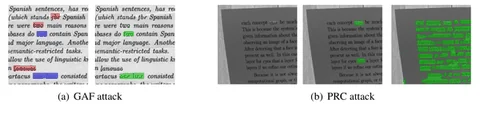
I’m drawn to a simple question: what are models actually relying on, and how do we find out? My favourite result so far is that document-forgery detectors were reading the JPEG compression grid rather than the forgery. Shifting the grid by 4 pixels, with no change to content or forgery, dropped a state-of-the-art detector from 0.73 to 0.11 F1. (one of three co-first authors, BMVC 2026 oral, to appear) I like experiments like that one: change something that shouldn’t matter, and see what breaks.
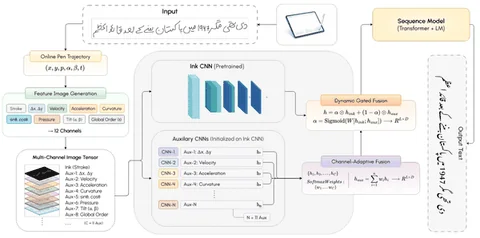
I’m also interested in making large models useful where data is scarce. For low-resource Urdu handwriting, I turned pen dynamics into image channels that a pretrained recognizer could use, reaching 3.66% CER against 7.28% for a QLoRA-fine-tuned Qwen3-VL-4B on the same test set. (first author, ICDAR 2026)
Lately I’ve been curious about generative and multimodal models: training them against verifiable rewards (my current work at DFKI) and what they lose when they are compressed (my final-year project with RPTU). (Directions I’m exploring)
I have worked with Prof. Faisal Shafait at NUST, with Prof. Andreas Dengel and Dr. Sheraz Ahmed at DFKI, and with Dr. Christian Weis at RPTU Kaiserslautern-Landau.
Things I’m curious about
- Shortcuts and evaluation: what models really use, and benchmarks that can tell
- Multimodal and generative models, especially for documents and text in images
- Learning from verifiable rewards
- Efficient models: distillation, compression and low-resource settings
I care about careful experimental practice: multiple seeds, significance tests, controlled ablations, and public code and data.
Outside research, I worked part-time as a computer vision engineer at CCRIPT, taking detection and tracking models from experiment to deployment on constrained hardware.
selected publications
news
| Sep 05, 2026 | Completed my research internship at RPTU Kaiserslautern-Landau (8 Jun – 5 Sep 2026). The distillation work continues as my final-year project. |
|---|---|
| Aug 31, 2026 | My first-author paper on online Urdu text-line recognition was presented as a poster at ICDAR 2026 in Vienna and is published in the Springer LNCS proceedings. Code and the OUHD-L dataset are public. |
| Aug 07, 2026 | Our paper Mistaking Periodicity for Manipulation was accepted as an oral at BMVC 2026. We show that document-tampering detectors rely on the JPEG 8×8 grid, and we introduce two attacks that break them. |
| Jun 08, 2026 | Started a research internship at RPTU Kaiserslautern-Landau with Dr. Christian Weis on foundation-model distillation for edge inference. |
| Aug 31, 2025 | Wrapped up my research internship at DFKI (1 Jun – 31 Aug 2025). This work led to our paper, accepted at BMVC 2026, on JPEG-induced bias in document tampering detection. |
| Jun 01, 2025 | Started a research internship at DFKI in Kaiserslautern, Germany, on document image forensics with Prof. Andreas Dengel and Dr. Sheraz Ahmed. |
| Jun 01, 2024 | Joined the TUKL-NUST R&D Center as an undergraduate researcher working on handwriting recognition with Prof. Faisal Shafait. |