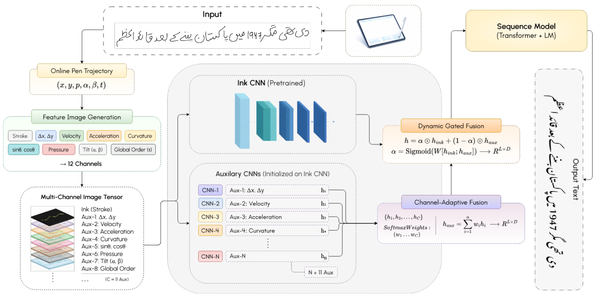
Robust recognition of Urdu has been challenging due to its cursive structure and extensive ligature variations. Modern pen devices capture rich spatio-temporal signals; however, state-of-the-art Urdu research predominantly focuses on offline images, and online-first transformer and vision-language approaches overfit in low-resource settings. We present two contributions: (i) OUHD-L, a new dataset of 2,403 online Urdu handwritten text lines from 311 writers, captured with the Wacom IoT paper device at fine-grained pen-trajectory resolution; and (ii) an encoding of online information as image channels that lets us reuse pre-trained offline Urdu text-line recognizers. Fusing online-derived feature images reduces character error rate from 4.21% (ink-only) to 3.66%, showing that converting online dynamics into image space bridges the data gap while reusing mature offline architectures.
@inproceedings{hussain2026online,title={Online Urdu Text-Line Recognition by Bridging Stroke Dynamics and Offline Representations},author={Hussain, Ali and Ahmad, Rafay and Moetesum, Momina and Ul-Hasan, Adnan and Shafait, Faisal},booktitle={International Conference on Document Analysis and Recognition (ICDAR)},year={2026},}
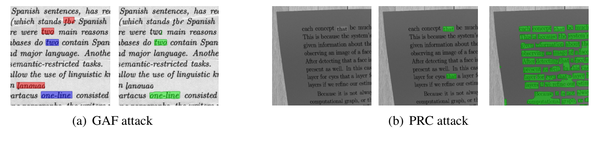
Deep models for document tampering detection increasingly rely on multimodal RGB+DCT architectures, implicitly assuming that JPEG block artifact grids (BAGs) provide stable cross-forgery cues. We show that this assumption embeds a strong inductive bias that fails under minimal, adversarially constructed perturbations. Unlike natural images, document images contain sharply bounded glyph structures, making grid-aligned manipulations trivial for an adversary. We formalize this through two complementary attacks. Grid-Aligned Forgery (GAF) preserves local JPEG block statistics by aligning copy-move, splicing, or generative manipulations to the 8x8 grid. Pad-Recompress-Crop (PRC) globally shifts the JPEG grid while preserving semantic content and geometry. We introduce Detection Failure Rate (DFR) and False Positive Area (FPA) to capture failure modes not measured by prior work. On DocTamper and T-SROIE, both attacks substantially degrade state-of-the-art and robustness-oriented detectors (CAT-Net, DTD, FFDN, DocForgeNet, ADCD-Net), indicating a strong bias toward JPEG-grid statistics.
@inproceedings{riaz2026periodicity,title={Mistaking Periodicity for Manipulation: JPEG-Induced Structural Bias in Document Tampering Detection},author={Riaz, Nauman and Hussain, Ali and Saifullah, Saifullah and Malik, Muhammad Imran and Agne, Stefan and Dengel, Andreas and Ahmed, Sheraz},booktitle={British Machine Vision Conference (BMVC)},year={2026},}